
Office of Faculty Affairs Highlights
The Office of Faculty Affairs prioritizes three areas of focus to meet our mission of supporting faculty and faculty leadership in the development of an exceptional learning community at the University of Kansas: Faculty Advancement & Recognition, Faculty Development & Growth, and Faculty Relations & Policy.
This page shares highlights of our work in these three areas, along with our office partnerships, for the 2024-25 academic year. As we are always looking ahead to what is on the horizon, we also provide previews of the new initiatives we are looking forward to.

As we work to strengthen our faculty community, we are thankful for our campus partners who help us make our work even more meaningful.
On behalf of the Faculty Affairs team, thank you for your engagement and partnership over this past year!
Faculty Advancement & Recognition
Through Faculty Advancement and Recognition, the Office of Faculty Affairs supports the processes for key milestones in the faculty career including faculty hiring, promotion and tenure, and sabbatical leaves. We also facilitate the distinguished professor selection process and host the Distinguished Professor Lecture Series. Additionally, we administer university teaching, service, and collaboration awards, oversee scholarly professorships and fellowships, and support the nomination process for external prestigious and highly prestigious research awards.
We appreciate the amount of time and energy that each university committee member dedicates to determining promotion and tenure, sabbatical leaves, distinguished professorships, and teaching and collaboration awards. In the 2025-26 academic year, our office facilitated 25 hours of committee work for the university committees on promotion and tenure, sabbatical leaves, distinguished professorships, and teaching awards.
Over the past few years, our efforts in streamlining awards calls and processes have led to steady increases in nominations of our teaching and collaboration awards, with an average increase of 74% in university award nominations from academic year 2023-24 to 2025-26. Last year, we were excited to implement our inaugural faculty service award, through support from the Provost Office, adding this honor to our portfolio of university awards, fellowships, and professorships. We have also worked to add more recognition to the Spotlight on Faculty Excellence program through our communication channels and university partnerships.
In the year ahead, the Office of Faculty Affairs will explore ways in which we can streamline faculty advancement processes. Through tools such as KU Faculty Insight, workflows can be developed for faculty and committee members, where materials and processes can be consolidated in one secure space. Our upcoming year will involve an exploration of this tool and how it can best work for units.
As the Kansas Board of Regents implements faculty activity reporting procedures, as a part of their workload policy updates, we will also continue supporting faculty in reporting their achievements through the Faculty Insight portal. We have offered numerous faculty activity reporting trainings to units and individual faculty and will continue to offer these trainings as needed, in order to accurately share the KU faculty story.
Faculty Advancement & Recognition Highlights 1
Faculty Advancement & Recognition Highlights
Faculty Development & Growth
The Office of Faculty Affairs facilitates Faculty Development and Growth as we provide faculty and academic staff with the tools and opportunities to succeed across all career stages. Our professional development initiatives span across various modalities to meet the needs of our diverse faculty and include small-group learning circles, faculty workshops, and faculty leadership development opportunities.
Last year we launched several new initiatives to support faculty, from building accessible courses to developing valuable skills at the mid-career stage. Through our partnership with the Digital Accessibility Team, we launched six Faculty How To at KU sessions, providing critical information on accessibility and remediation efforts. We hosted our first Faculty Idea Exchange, focusing on the Student Survey of Teaching Working Group findings, and we offered our first Faculty Collaborative programs: Faculty Vitality at the Mid-Career Stage and Faculty THRIVE.
We hosted our first annual Early Career Faculty Foundations workshop, spotlighting topics such as instructional development, research impact, avoiding burnout, and understanding the impact of AI in the academy. We offered our new workshop on graduate student mentoring – which was designed and offered in partnership with Graduate and Postdoctoral Affairs – with over 60 faculty and staff participating during the 2025-26 academic year. We also hosted our first New Associate Deans, Chairs, & Directors Orientation to support unit and department leaders as they transitioned into their new roles, covering topics that ranged from data-informed decision making, managing finances and budgets, providing people support and development, and engaging in program review and development.
In addition, we continued our outreach to and programming for New and Early Career Faculty, which included our summer email campaign, drop-in office hours, New Faculty Orientation, and New Faculty How To at KU sessions. We offered our bi-annual Associate Deans, Chairs, and Directors Workshops and monthly ADCD Essential Series lunch-and-learns and supported valuable discussions between faculty at all career stages through our Faculty Learning Circles. Senior Administrative Fellows continues to be a signature leadership development program that we offer each year, and our third annual Faculty Development Academies Week featured sessions on academic leadership, global engagement, research and discovery, digital accessibility, and graduate student mentoring.
We continue to grow our programming portfolio to meet the needs of faculty in the current climate. This past August, we welcomed new part-time faculty to their own version of our New Faculty Orientation focused on developing a strong foundation as they begin their journey at KU. We also hosted our second annual New ADCD Orientation in August and our Fall ADCD Essentials Workshop in September, and continue to develop programming for faculty leadership that pertain to timely topics and interests, including building a culture of mentoring and providing departmental support in times of change. We will also feature a new ADCD Faculty Learning Circle in the spring and a “preparing for leadership” Faculty Collaborative open to all faculty regardless of their career-stage or role. For all faculty, we are also offering Crucial Conversations® for Mastering Dialogue, a new workshop series, which supports the development of nine powerful communication skills to support conversations when the stakes are high.
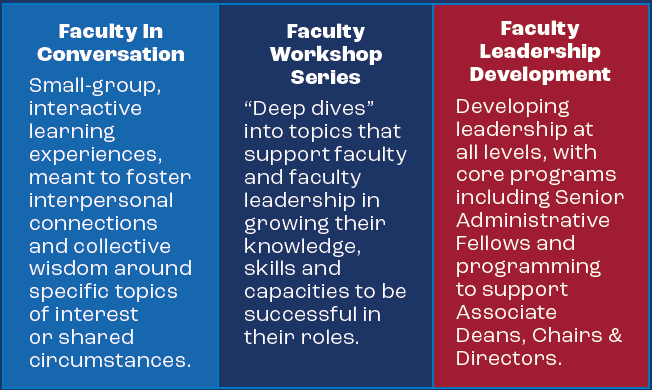
The Office of Faculty Affairs has created a faculty development framework consisting of three program types, designed to help faculty identify the opportunities that best fit their needs during any given moment along their career journey.
Last year we launched several new initiatives to support faculty, from building accessible courses to developing valuable skills at the mid-career stage. Through our partnership with the Digital Accessibility Team, we launched six Faculty How To at KU sessions, providing critical information on accessibility and remediation efforts. We hosted our first Faculty Idea Exchange, focusing on the Student Survey of Teaching Working Group findings, and we offered our first Faculty Collaborative programs: Faculty Vitality at the Mid-Career Stage and Faculty THRIVE.
We hosted our first annual Early Career Faculty Foundations workshop, spotlighting topics such as instructional development, research impact, avoiding burnout, and understanding the impact of AI in the academy. We offered our new workshop on graduate student mentoring – which was designed and offered in partnership with Graduate and Postdoctoral Affairs – with over 60 faculty and staff participating during the 2025-26 academic year. We also hosted our first New Associate Deans, Chairs, & Directors Orientation to support unit and department leaders as they transitioned into their new roles, covering topics that ranged from data-informed decision making, managing finances and budgets, providing people support and development, and engaging in program review and development.
In addition, we continued our outreach to and programming for New and Early Career Faculty, which included our summer email campaign, drop-in office hours, New Faculty Orientation, and New Faculty How To at KU sessions. We offered our bi-annual Associate Deans, Chairs, and Directors Workshops and monthly ADCD Essential Series lunch-and-learns and supported valuable discussions between faculty at all career stages through our Faculty Learning Circles. Senior Administrative Fellows continues to be a signature leadership development program that we offer each year, and our third annual Faculty Development Academies Week featured sessions on academic leadership, global engagement, research and discovery, digital accessibility, and graduate student mentoring.
We continue to grow our programming portfolio to meet the needs of faculty in the current climate. This past August, we welcomed new part-time faculty to their own version of our New Faculty Orientation focused on developing a strong foundation as they begin their journey at KU. We also hosted our second annual New ADCD Orientation in August and our Fall ADCD Essentials Workshop in September, and continue to develop programming for faculty leadership that pertain to timely topics and interests, including building a culture of mentoring and providing departmental support in times of change. We will also feature a new ADCD Faculty Learning Circle in the spring and a “preparing for leadership” Faculty Collaborative open to all faculty regardless of their career-stage or role. For all faculty, we are also offering Crucial Conversations® for Mastering Dialogue, a new workshop series, which supports the development of nine powerful communication skills to support conversations when the stakes are high.
The Office of Faculty Affairs has created a faculty development framework consisting of three program types, designed to help faculty identify the opportunities that best fit their needs during any given moment along their career journey.
Faculty Development & Growth Highlights 1
Faculty Development & Growth Highlights 2
Faculty Relations & Policy
In the area of Faculty Relations and Policy, the Office of Faculty Affairs is involved with the development and review of policy that overlaps with the faculty role. We offer policy support through education, collaborate with governance on faculty and academic-related topics, and engage in collective bargaining with United Academics of KU (UAKU) around the terms and conditions of employment. The office is also responsible for processes that pertain to faculty hiring, external activity reporting, workplace leave, differential allocations of effort, and additional pay.
Much of the 2025-26 academic year was spent focused on collective bargaining with UAKU, which resulted in 60 negotiation sessions and a finalized contract comprised of 37 articles, on April 20, 2026. In anticipation of a contract, the Office of Faculty Affairs planned for a spring and summer of training on the collective bargaining agreement, workshops for impacted policies and alignment with the contract, and resources for faculty to utilize when planning for contract implementation within their units. Additionally, we issued 41 policy development mini grants to support units in their policy alignment efforts in the year ahead.
We have developed numerous resources in relation to the collective bargaining agreement, including a faculty and academic staff classification and job titles reference document, allowing units to more clearly understand each faculty classification and the qualifications, terms, and evaluation processes involved with each title. We also updated review forms and processes for instructional faculty, to aid in contract
alignment, providing definitions and resources on our website.
In the year ahead the Office of Faculty Affairs will work with Policy Administration, Human Resources, General Council, and University Governance to review and ensure policy revisions align with the collective bargaining agreement by the April 15, 2027 deadline. There are nearly 500 policies at the university, school and department levels that are impacted by the collective bargaining agreement. Although the first contract is finalized, there are several reopeners (director titles, supplemental salary, intellectual property, and compensation) in which negotiations will continue during the 2026-27 academic year.
In the coming year, we will prepare a report to the Kansas Board of Regents on faculty workload and activities that contribute to the university’s mission, students, the state, and society at large. Ahead of the report, we will assist faculty and units in understanding activity reporting requirements and how to report activities as efficiently as possible. To do this, we will offer individual faculty training in person and online, as well as unit-level training, to walk through the reporting process related to their unique scholarship. We will also audit university faculty processes to identify procedures that could become more efficient by transitioning to an online workflow system. This plan will take place over several years, with the goal of making faculty procedures easier and faster, so they can focus less on paperwork and more on the important work of teaching, research, and service.